GlusterFS vs. DRBD: Replication, Consistency, and Choosing an HA Design
EdwardMoon
GlusterFS and DRBD both replicate data over a network, but they are not interchangeable. GlusterFS is a distributed filesystem presenting a file namespace across multiple bricks. DRBD replicates a block device beneath the filesystem. Define the application’s required access semantics first to avoid choosing the wrong technology.
This article goes beyond the shorthand of GlusterFS for file servers and DRBD for databases. It compares write acknowledgment, concurrent mounts, network partitions, quorum, fencing, healing, and failover responsibilities, with practical inspection commands and selection checklists.
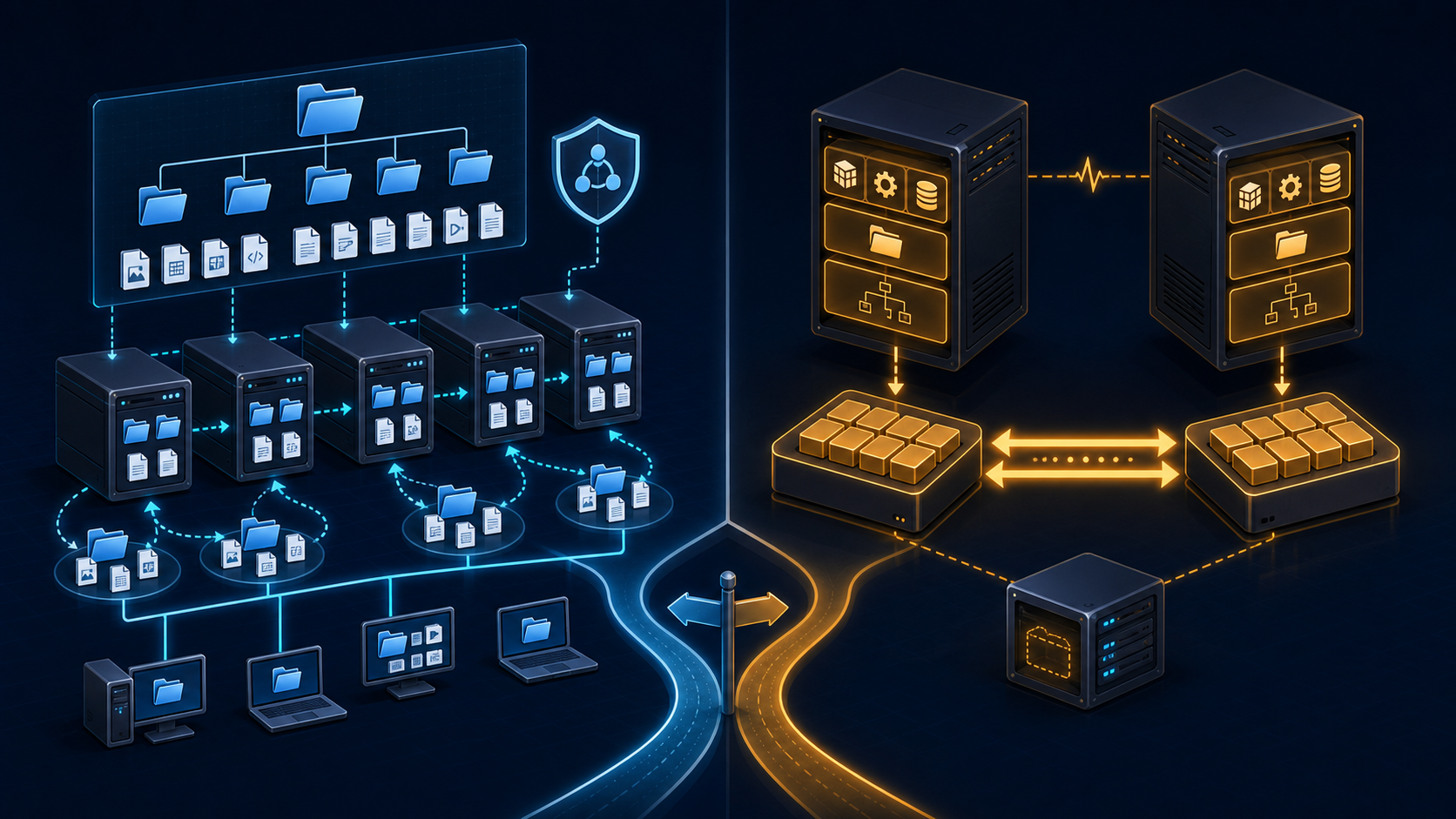
Architectural Differences
| Aspect | GlusterFS Replica | DRBD 9 |
|---|---|---|
| Replication layer | Files, directories, and metadata | Changed blocks on a block device |
| I/O path | Clients/FUSE communicate with multiple bricks | A kernel module forwards local block I/O to peers |
| Filesystem above the replication layer | GlusterFS provides the shared namespace itself | Requires ext4, XFS, or a suitably configured cluster filesystem |
| Typical access model | Multiple clients mount concurrently | Single-primary active/passive is common |
| Scaling model | Distributes replica sets to scale capacity and clients | DRBD 9 supports multiple replication peers but is not a distributed filesystem |
| Recovery unit | Per-file healing and split-brain resolution | Block resynchronization using a dirty bitmap |
The Distinction in Practical Terms
- If several servers must read and write the same file tree concurrently, evaluate GlusterFS’s shared-file semantics.
- If one service must continue on another node using its replicated local block device, evaluate single-primary DRBD.
- In both cases, replication is not backup: deletion, ransomware, and logical errors can be replicated too.
Write Acknowledgment and Latency
On a GlusterFS replica volume, the client’s AFR layer sends file operations to the bricks in a replica set. Healing may be required after failures. If separate network partitions modify the same file, split brain can prevent automatic selection of an authoritative copy. Increasing the replica count alone does not complete the quorum policy.
DRBD Protocol C is synchronous: it acknowledges completion to the upper layer after local and remote disk writes are confirmed. It reduces RPO for a single-node loss, but network round-trip time and both storage devices’ write latency affect the application. Protocols A and B acknowledge writes differently, so DRBD is not always synchronous.
Identical blocks do not prove that database transactions or the filesystem are healthy. Separately test cache durability after power loss, filesystem journaling, application fsync behavior, and crash recovery.
What Concurrent Access Actually Means
GlusterFS is designed for multiple clients to mount a volume, but applications must not directly access the underlying brick directories as a shared-data path. Use the Gluster client protocol so AFR consistency and healing metadata are maintained.
With single-primary DRBD, the standard design mounts an ordinary filesystem such as ext4 or XFS on one Primary only. DRBD also supports dual-primary operation, but concurrent mounts require a cluster filesystem with distributed locking, such as GFS2 or OCFS2, and fencing. Mounting ordinary XFS on both nodes at once can corrupt it.
Quorum and Split Brain
Replica 2 cannot maximize both consistency and availability during a network partition. Gluster’s official documentation describes replica 3 or arbiter volumes with client quorum as ways to reduce split-brain risk. An arbiter is not a third full data copy; it uses metadata to help decide which copy is authoritative.
Read-Only GlusterFS Status Checks
sudo gluster peer status
sudo gluster volume list
sudo gluster volume info <VOLNAME>
sudo gluster volume status <VOLNAME> detail
Inspect Healing and Split-Brain Lists
sudo gluster volume heal <VOLNAME> info summary
sudo gluster volume heal <VOLNAME> info
sudo gluster volume heal <VOLNAME> info split-brain
Choosing a source brick based only on file size or modification time can overwrite valid data. Determine the authoritative copy with the application owner, secure a backup, then apply per-file recovery procedures.
Inspect Current Quorum Options
sudo gluster volume get <VOLNAME> cluster.quorum-type
sudo gluster volume get <VOLNAME> cluster.quorum-count
sudo gluster volume get <VOLNAME> cluster.server-quorum-type
sudo gluster volume get <VOLNAME> all | grep -Ei 'quorum|arbiter'
DRBD 9 Roles, Protocols, and Quorum
A DRBD resource has a Primary or Secondary role. Single-primary is the common HA pattern, but DRBD 9 is not limited to two nodes; it can replicate one resource across several hosts. More nodes also complicate connections, metadata, resynchronization, and quorum design, so distinguish supported functionality from operational suitability.
Check DRBD State and Replication Progress
sudo drbdadm status
sudo drbdsetup status --statistics
cat /proc/drbd
journalctl -k -b | grep -i drbd
Dry-Run Before Applying Configuration Changes
sudo drbdadm -d adjust <RESOURCE>
sudo drbdadm dump <RESOURCE>
DRBD does not by itself promote a surviving Secondary and start the application. Pacemaker, DRBD Reactor, or a strict manual procedure must coordinate stopping the service, unmounting, changing roles, mounting, and starting the VIP and application.
Inspect Quorum and Role State
sudo drbdsetup status --verbose --statistics
sudo drbdadm status <RESOURCE>

# If you also use Pacemaker
sudo crm_mon -1Arf
When communication fails between only two nodes, the network alone cannot establish which surviving copy is authoritative. Design DRBD 9 diskless tiebreakers/quorum, Pacemaker fencing/STONITH, and independent power and network paths together.
Why Failover Works Differently
| Stage | GlusterFS | DRBD |
|---|---|---|
| Failure detection | The client detects a failed brick connection | Detects peer connection or disk-state changes |
| Decision to permit writes | AFR client quorum and volume state | Role, disk state, and DRBD quorum |
| Data-path transition | The client communicates with surviving bricks | A cluster manager promotes, mounts, and starts services |
| Recovery | Per-file healing and split-brain resolution | Block resynchronization and role reintegration |
| Required external components | Working redundant volfile servers and monitoring | Usually a cluster manager and fencing |
GlusterFS path failover and DRBD service failover are different operations. The former changes a distributed file client’s I/O path; the latter is a cluster procedure that moves the filesystem and application above the block device in a defined order.
Choose by Workload
The table compares access requirements. Before adopting either technology, separately verify security support from the GlusterFS community or distribution supplier, and compatibility between DRBD’s kernel module/utilities and the host kernel. Even a functional match is not a production candidate without a maintainable package source.
| Requirement | Consider first | Reason and caveats |
|---|---|---|
| Several web nodes sharing uploaded files | GlusterFS | Fits concurrent file access, but test small-file performance and healing |
| Active/passive operation of one database using a local filesystem | DRBD | Evaluate Protocol C and a cluster manager, and compare with the database’s native replication |
| Horizontally scalable object storage | Reconsider both | S3-compatible object storage may better match the access semantics |
| VM live migration | DRBD, conditionally | Requires dual-primary, a cluster filesystem, and fencing, or dedicated virtualization integration |
| Large read-only distribution assets | GlusterFS or object storage | Also compare caches, CDNs, and distribution pipelines |
| Backups and long-term retention | Neither is sufficient alone | Requires independent backups with versioning, immutability, and off-site recovery |
Questions to Answer Before Choosing
- Must multiple nodes write the same filesystem concurrently, or is one writer enough?
- What RPO and RTO are acceptable, and can the workload tolerate synchronous replication latency?
- During a network partition, should availability or consistency take priority?
- Is there an independent third voting path and an appropriate fencing design?
- Have you measured performance during healthy replication, degraded writes, and resynchronization?
- Do you have independent backups and actual restore tests for deletion, corruption, and ransomware?
Operations Checklist
- Separate replication links from service traffic and monitor latency, packet loss, and bandwidth.
- Test service behavior during node failure, link loss, reboot, and resynchronization, not just healthy operation.
- Alert on GlusterFS heal backlogs and split brain, and on DRBD role, disk, connection, and quorum states.
- Keep force procedures that make both sides writable out of routine operating runbooks.
- Maintain immutable, off-site backups with defined retention independently of replication, and regularly verify restoration.
Official Documentation and Related Guides
- GlusterFS volume configuration documentation
- GlusterFS healing and split-brain documentation
- GlusterFS arbiter and quorum documentation
- DRBD 9 User’s Guide
- GlusterFS Deployment Guide
- DRBD and Pacemaker Deployment Guide
Conclusion
Choose between GlusterFS and DRBD according to the required file-sharing or block-failover semantics. GlusterFS supplies a distributed file namespace and healing; DRBD supplies block replication and explicit role transitions. Either choice needs a complete failure model that includes quorum, fencing, observability, and independent backups to deliver high availability.